Silicon Valley is mostly a world of practical technology—applying principles from pure science to create handy gadgets. But today, Hewlett Packard announced a new electrical component born of theoretical physics. The device, a nanoscale component called a "memristor," requires no power to retain data, which it can store more densely than a hard drive and access about as fast as a computer’s RAM memory—potentially allowing it to replace both components in the future.
Memristors can function in either a digital mode, in which a memory cell is “on” or “off,” or in analog mode, in which each cell holds some value in between. These values grow every time the cell receives an electrical signal, mimicking the way neurons in the brain build stronger memories the more they are stimulated.
The memristor was theorized in the early seventies by an electrical engineer name Leon Chua, but it took decades before anyone could prove it exists. The process was similar to particle physics, in which mathematicians first propose a particle and then experimenters eventually find it—or don’t. (The hottest current example is the search for the theoretical Higgs boson, aka the “god particle.”) Chua’s mythical electrical component didn’t show up until recently when HP researchers were studying the electrical properties of nanoscale materials and came upon a few that acted suspiciously like the memristor. After some refinements, they invented exactly what Chua theorized.
More.

For years, now, Pentagon-backed researchers have been trying to create cyborg insects that could serve as living, remote-controlled spies. The problem is, those modified bugs never survived long enough to be useful. Now, Georgia Tech professor Robert Michelson says he's managed to get the bug 'borgs to live into adulthood.
Ultimately, DARPA wants these MEMS [micro-mechanical systems] to remote-operately the insects, either through "direct electrical muscle excitation, electrical stimulation of neurons, projection of ultrasonic pulses simulating bats, [or] projection of pheromones," the agency says. The ultimate goal would be to have the cyborgs "carry one or more sensors, such as a microphone or a gas sensor, [and] relay back information."
More.

PORTLAND, Ore. — A new superconducting material fabricated by a Canadian-German team has been fabricated out of a silicon-hydrogen compound and does not require cooling.
Instead of super-cooling the material, as is necessary for conventional superconductors, the new material is instead super-compressed. The researchers claim that the new material could sidestep the cooling requirement, thereby enabling superconducting wires that work at room temperature.
"If you put hydrogen compounds under enough pressure, you can get superconductivity," said professor John Tse of the University of Saskatchewan. "These new superconductors can be operated at higher temperatures, perhaps without a refrigerant."
More.

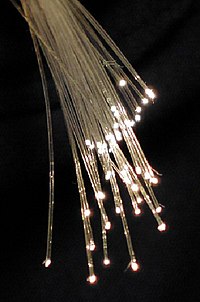
Solving the "last mile" problem is a goal both the telecommunication and cable industries have pursued for years without discovering a single, easily implementable solution. Now, researchers at the Korea Institute of Science and Technology think they have developed a new type of plastic optical fiber that could potentially be used to provide low-cost fiber connectivity from the consumer to the provider.
Plastic optical fiber isn't as fast as traditional glass, but its 2.5GB/s transfer speed still represents a meteoric leap beyond copper. Currently, the majority of optical fiber is prone to breakage (being made from glass), cannot bend, and can be difficult to connect. The Korea Times reports that the new plastic fiber can be easily bent and connected to additional lines, making it useful in hard-to-reach homes or apartments.
...
Verizon, in particular, might be interested in plastic optical fibers. The company's FiOS technology runs fiber directly into the home of each subscriber, a choice that was costing the company well in excess of $900 per subscriber as of last March. Verizon has already shown an interest in flexible cable, and announced last summer that it wanted to purchase Corning's new flexible optical fiber as soon as it became available in quantity.
More.