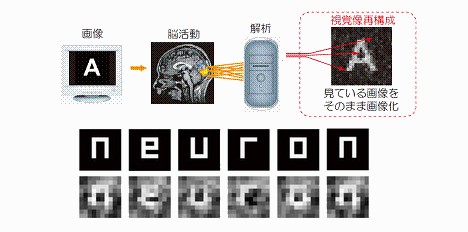
Researchers from Japan’s ATR Computational Neuroscience Laboratories have developed new brain analysis technology that can reconstruct the images inside a person’s mind and display them on a computer monitor, it was announced on December 11. According to the researchers, further development of the technology may soon make it possible to view other people’s dreams while they sleep.
The scientists were able to reconstruct various images viewed by a person by analyzing changes in their cerebral blood flow. Using a functional magnetic resonance imaging (fMRI) machine, the researchers first mapped the blood flow changes that occurred in the cerebral visual cortex as subjects viewed various images held in front of their eyes. Subjects were shown 400 random 10 x 10 pixel black-and-white images for a period of 12 seconds each. While the fMRI machine monitored the changes in brain activity, a computer crunched the data and learned to associate the various changes in brain activity with the different image designs.
Then, when the test subjects were shown a completely new set of images, such as the letters N-E-U-R-O-N, the system was able to reconstruct and display what the test subjects were viewing based solely on their brain activity.
For now, the system is only able to reproduce simple black-and-white images. But Dr. Kang Cheng, a researcher from the RIKEN Brain Science Institute, suggests that improving the measurement accuracy will make it possible to reproduce images in color.
“These results are a breakthrough in terms of understanding brain activity,” says Dr. Cheng. “In as little as 10 years, advances in this field of research may make it possible to read a person’s thoughts with some degree of accuracy.”
The researchers suggest a future version of this technology could be applied in the fields of art and design — particularly if it becomes possible to quickly and accurately access images existing inside an artist’s head. The technology might also lead to new treatments for conditions such as psychiatric disorders involving hallucinations, by providing doctors a direct window into the mind of the patient.
ATR chief researcher Yukiyasu Kamitani says, “This technology can also be applied to senses other than vision. In the future, it may also become possible to read feelings and complicated emotional states.”
The research results appear in the December 11 issue of US science journal Neuron.
More on Brain Imaging
Original article in Japanese