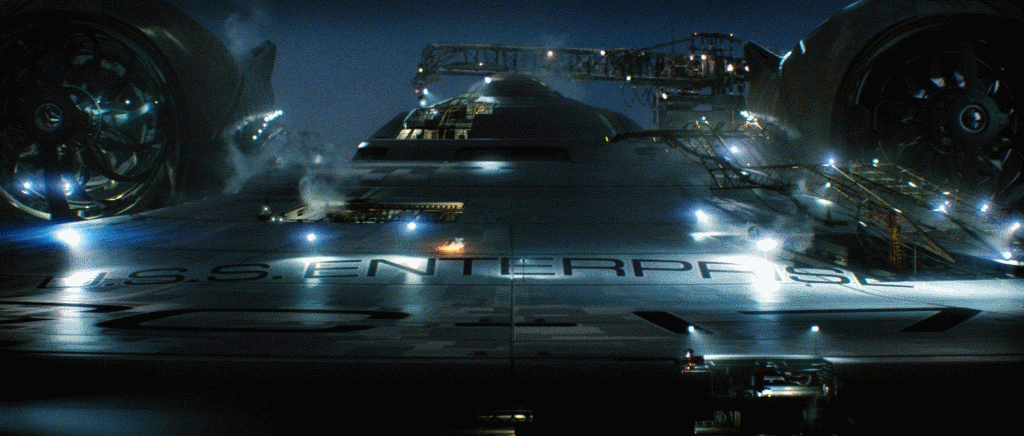
Yesterday, Paramount released the first full photo of the USS Enterprise from JJ Abrams‘ Star Trek.
More Evolution of the Enterprise
Yesterday, Paramount released the first full photo of the USS Enterprise from JJ Abrams‘ Star Trek.

SCI FI Channel has given a green light for production to begin on Caprica, a two-hour backdoor pilot and Battlestar Galactica prequel from executive producers Ronald D. Moore and David Eick. Production is slated to begin in Vancouver, Canada, this spring.
Set 50 years before the events of Battlestar Galactica, Caprica follows two rival families--the Greystones and the Adamas --as they grow, compete and thrive in the vibrant world of the 12 Colonies. Enmeshed in the burgeoning technology of artificial intelligence and robotics that will eventually lead to the creation of the Cylons, the two houses go toe to toe.
Peter Berg is attached to direct a bigscreen adaptation of Frank Herbert's classic sci-fi novel "Dune" for Paramount Pictures.
Herbert's 1965 novel is a sweeping, futuristic tale set on the remote desert planet Arrakis, which produces the interstellar empire's sole source of the spice Melange -- used for distant space travel. An empirewide power struggle ensues over the control of the spice. Berg would be the latest helmer to take a crack at the property, which spawned a 1984 David Lynch film as well as a 2000 Sci Fi Channel miniseries starring William Hurt.
The project is out to writers, with the producers looking for a faithful adaptation of the Hugo- and Nebula Award-winning book. The filmmakers consider its theme of finite ecological resources particularly timely.
New Amsterdam's Richard Rubenstein, who produced Sci Fi's "Dune" and sequel "Children of Dune," is also producing alongside Sarah Aubrey of Film 44, Berg's production banner. John Harrison and Mike Messina exec produce.
Actor-turned-helmer Berg most recently directed the upcoming Will Smith starrer "Hancock." His directing credits include "The Kingdom" and "Friday Night Lights."

Everything about this novel is interesting, even the experience of reading it. For Us, the Living: A Comedy of Customs was written in 1938-1939; it is Robert A. Heinlein's first extended piece of fiction, and was never published because in 1939 it was not simply unsold: It was probably unpublishable. Over the 20th century, didactic novels of a utopian bent had been increasingly perceived as unmarketable (dystopias like Huxley's Brave New World [1932] or Orwell's Nineteen Eighty-Four [1949] do very much better); but more specifically, For Us, the Living promulgates the kind of arguments about sex, religion, politics and economics that normally gain publication through fringe presses, not the trade publishers Heinlein submitted his manuscript to, Random House and Macmillan (which did all the same publish B.F. Skinner's Walden Two in 1948).
For us, though, in 2004, For Us, the Living, as far as its arguments go, is pure Heinlein; indeed, because almost every radical notion he ever generated appears here in utero, the book rewrites our sense of Heinlein's entire career; and because Heinlein's career, as we understood it, has always seemed expressive of the nature of American SF from 1939 to 1966, this small, slightly stumblebum first novel rewrites our understanding of those years, especially the early ones, when John W. Campbell Jr. was attempting to shape the nascent genre into a weapon of future-purification.
It has certainly been well known that Heinlein (unlike the younger Isaac Asimov) found Campbell's personality and diktats less than persuasive, but the degree to which he corralled his imaginative intellect, in order to help create the SF that missed the boat, has never I think really been guessed. In a nutshell, the ideas about sex and privacy and government that inch into view—just a little pruriently, perhaps—through the finger-wagging pages of For Us, the Living are exactly the ideas that the professional writer Heinlein only let himself begin to utter again in 1959, with Starship Troopers. I'm not about to suggest that if Heinlein had been able to publish openly in the pages of Astounding in 1939, SF would have gotten the future right; I would suggest, however, that if Heinlein, and his colleagues, had been able to publish adult SF in Astounding and its fellow journals, then SF might not have done such a grotesquely poor job of prefiguring something of the flavor of actually living here at the onset of 2004.
Watching the Competent Man being born
A short notice of this text cannot begin to articulate the minutiae of similtude and difference between early Heinlein and late. Central to both periods is the concept of the absolute privacy of the individual citizen of America; as the new Constitution of 2028 states:
Every citizen is free to perform any act which does not hamper the equal freedom of another. No law shall forbid the performance of any act, which does not damage the physical or economic welfare of any other person. No act shall constitute a violation of a law valid under this provision unless there is such damage, or immediate present danger of such damage resulting from that act.
This is a radical doctrine, as Heinlein clearly argues, for it means
the end of the blue laws, and a grisly unconscious symbiosis between the underworld and the organized churches—for the greatest bulwark of the underworld were always the moral creeds of the churches.
And so forth. These two quotes, which appear 200 pages apart in the text, are, as one might put it, just like Heinlein. The consequences, direct and cognate, which For Us, the Living doesn't really go very far to dramatize, run from the absolute and genuine separation of church and state, to the liberation of women, to very widespread private nudity, and to what we call, in this world, "open marriage."
The story through which these arguments are put—they include long lessons in Social Credit—begins typically. A young man named Perry from 1939 is, more or less magically, transported to 2087, where he learns about the brave new world which has evolved. He is necessarily as stupid as most of his fellow visitors to utopia—else there would be no reason to tell him everything down to the last detail—but gradually changes into a Competent Man, piloting the first spaceship around the moon in a slingshot ending, though before he gets Competent he has to spend a while in a psychological rehabilitation unit after biffing the nude male friend of his new nude lover Diana because he has failed to grasp the implications of privacy as applied to sexual freedom. The language in which this is all laid down (the word "breasts" never appears, though "breast"—designating a vague frontal region—shows up lots) is perhaps the most poignant residue of the claptrap writers had to grapple with just a few decades ago.
...


I am not going to talk about religious beliefs but about matters so obvious that it has gone out of style to mention them. I believe in my neighbors. I know their faults, and I know that their virtues far outweigh their faults.
Take Father Michael, down our road apiece. I’m not of his creed, but I know that goodness and charity and loving kindness shine in his daily actions. I believe in Father Mike. If I’m in trouble, I’ll go to him. My next door neighbor’s a veterinary doctor. Doc will get out of bed after a hard day to help a stray cat—no fee, no prospect of a fee. I believe in Doc.
...
I believe that almost all politicians are honest. For every bribed alderman, there are hundreds of politicians—low paid or not paid at all—doing their level best without thanks or glory to make our system work. If this were not true, we would never have gotten past the Thirteen Colonies.
...
And finally, I believe in my whole race—yellow, white, black, red, brown—in the honesty, courage, intelligence, durability, and goodness of the overwhelming majority of my brothers and sisters everywhere on this planet. I am proud to be a human being. I believe that we have come this far by the skin of our teeth—that we always make it just for the skin of our teeth—but that we will always make it, survive, endure.
I believe that this hairless embryo with the aching oversized braincase and the opposable thumb—this animal barely up from the apes—will endure, will endure longer than his home planet, will spread out to the other planets—to the stars and beyond—carrying with him his honesty, his insatiable curiosity, his unlimited courage, and his noble essential decency. This I believe with all my heart.
Robert A. Heinlein won four Hugo Awards during his 50-year career as a science fiction writer. Born and raised in Missouri, he graduated from the U.S. Naval Academy in 1929 and did aeronautical engineering for the Navy during World War II. Heinlein’s books include Starship Troopers and Stranger in a Strange Land.

“What was the dirtiest story I ever wrote?” wrote Kurt Vonnegut in “Palm Sunday,” his 1981 “autobiographical collage.” “Surely ‘The Big Space F**k,’ the first story of literature to have ‘f**k’ in its title. It was probably the last short story I will ever write. I did it for my friend Harlan Ellison, who printed it in his anthology ‘Again, Dangerous Visions.’” It’s a terrific, and terrifically relevant, story. I found only a fragment of it on the Web. Here’s the story in full as it appeared in “Palm Sunday,” courtesy of the Notebooks’ head clerk, O.C.R.
----
In 1987 it became possible in the United States of America for a young person to sue his parents for the way he had been raised. He could take them to court and make them pay money and even serve jail terms for serious mistakes they made when he was just a helpless little kid. This was not only an effort to achieve justice but to discourage reproduction, since there wasn’t anything much to eat any more. Abortions were free. In fact, any woman who volunteered for one got her choice of a bathroom scale or a table lamp.

The long-eared jerboa lives in the desert of northwestern China and southern Mongolia. Little is known about its behavior, but it is believed that its movement by quick jumps aids it in evading predators. Currently the long-eared jerboa is believed to be threatened by human disturbance of its deserts, livestock intrusion, and droughts. Dr. Jonathan Baillie, the lead scientists on the expedition which took the footage, described his first encounter with the small mammal on the EDGE blog: "As I peered in the trap my eyes were met with one of the most unusual creatures I had ever seen. I could not believe that such a strange and delicate looking animal could be at home in such a harsh environment."

...scientists have developed a way to use light to grab and move minuscule particles on a microchip. The research could lead to fine-grained biological sensors and other precisely built nanoscale devices.
The work by Massachusetts Institute of Technology researchers could extend the possibilities for "optical tweezers" _ super-focused beams of light that have been used for years to study and manipulate tiny biological structures or even individual atoms.
...
Lang and Appleyard proved their technique by getting 16 live E. coli cells to spell out "MIT" on a chip. The long-term potential is more practical: Lang envisions using the system to cram high-resolution sensors in very small spaces _ for disease detectors, for example _ and to connect silicon-based electronics to living tissues and other "biological interfaces."

It's smaller than it seems in pictures. I'd say its about perfect scale to the old Star Wars action figures. I would have killed for one of these back in the day. Not sure if it'll fit in the X Wing from Hasbro, but I'm guessing a yes. The Japanese import has an IR lightsaber remote which controls the action.
When operating, the lightsaber can make R2D2 move forward and back but when it moves back, he spins. That's how the little guy turns. While on the move, his dome pivots a little bit side to side, and an a red LED goes off, as if he's looking around for trouble or a terminal interface to jack into. The whistling and purring R2 does while moving is emitted from the lightsaber.

Use live action, animation, shadow puppets -- whatever you want -- to tell a story.

Hugo and Nebula award-winning sci-fi and fantasy author Orson Scott Card has made a name for himself with best sellers like Ender's Game and Speaker for the Dead. Now he's taking his storytelling abilities to the world of video games with independent game developer Chair Entertainment.
While Card's writing fueled classic LucasArts games The Dig and The Secret of Monkey Island, his latest book, Empire, is part of a multiformat franchise that was conceived from the ground up for video games, comic books, novels and films.
Empire, which hits bookstores Nov. 28 from Tor Publishing, is set in a near-future America in which a civil war has erupted between the political left and the right. Card was involved from day one in building the franchise across entertainment mediums. He took some time to talk about his latest venture and to explain why he doesn't enjoy playing video games any more.